
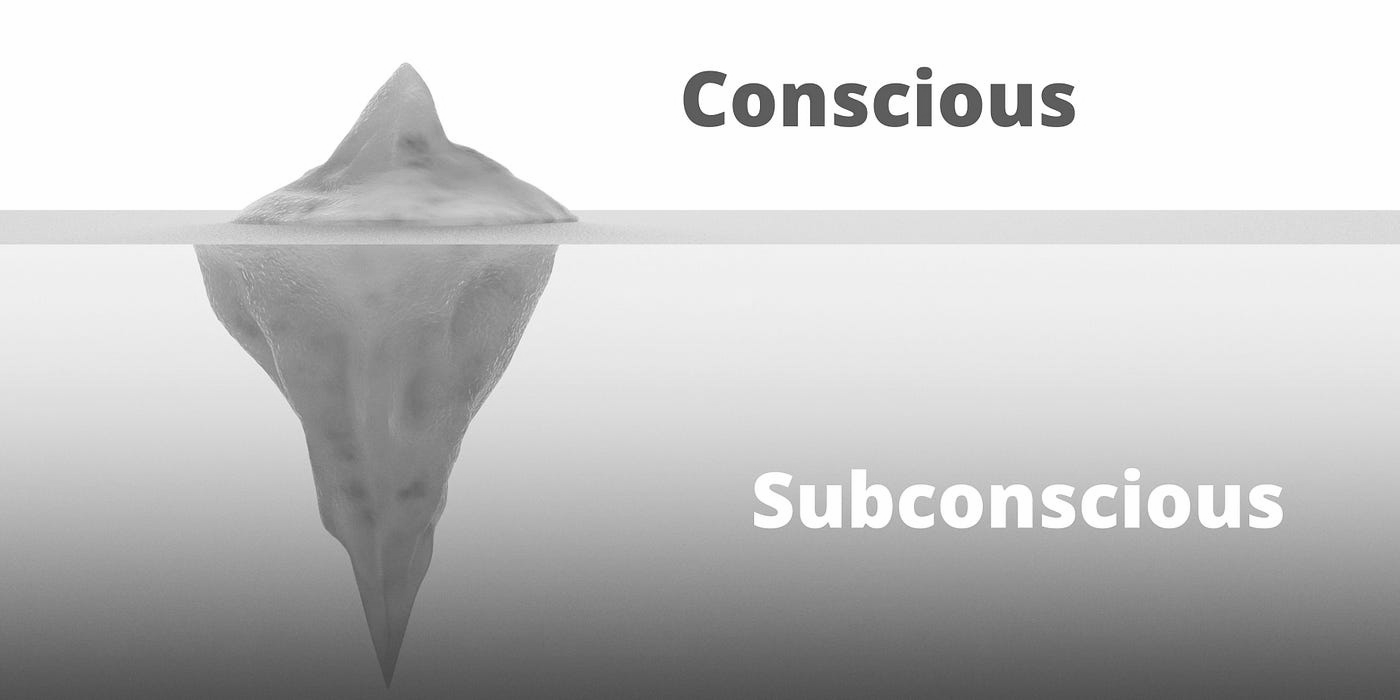
Psychology talks about the subconscious mind that learns by absorption and repetition. The subconscious mind is that part of our mental apparatus that is active 24/7 but not immediately available to conscious awareness. If the conscious mind is analogous to present moment focussed attention then the subconscious would be the peripheral awareness that absorbs everything from the environment but does not need immediate attention. However, it affects thoughts, feelings, and behaviour without entering the awareness, sometimes called tendencies or impressions. The subconscious imprints condition the conscious mind. Hence, in education, materials, environment, behaviour and subtle thoughts and feelings also matter, as the child’s mind absorbs everything.
Here too, we see the importance of the environment and free play in child development. Especially in early childhood when the rational thinking and discriminative faculties of the conscious mind are not yet developed, the environment becomes the all-encompassing source of learning.
The cognitive development theory developed by Jean Piaget (1896-1980) in the early 20th century is quite interesting. He is quoted as saying, “You cannot teach concepts verbally, you must use a method founded on the child’s activity.” The child’s activity is nothing but play and free exploration. Children like to create stories while playing, which we generally term as pretend play, however, the child through his play assimilates and expresses what he has learnt from the environment. Jean Piaget’s theory proposes that a child goes through four distinct phases of cognitive development:
- Sensorimotor (0-2 years)- The child learns using the senses and motor skills, focusing on what they see and do in the immediate environment. Visual and physical interactions.
- Preoperational (2-7 years)- the child can learn through symbols, like words, pictures, people, and ideas. At this stage, he can mimic, pretend, draw, visualise and describe.
- Concrete operational (7-11 years)- At this stage the child can show logical, concrete reasoning and also empathy. He can think in more abstract terms.
- Formal operational (12 years and above)- At this stage, scientific reasoning, and abstract thinking using symbols happens. Ideas of self-identity and justice also develop during this time.
This theory goes to show how education and learning if aligned with the natural cognitive developmental stages can help the child immensely. In terms of books and toys, keeping the cognitive requirements at each stage will help produce the right kind of material for different age groups. Play and self-discovery are still at the core of each stage.
